Silk Bridge Journal

Why even the best supplier should never be your only one
Even when cooperation with your current manufacturer is running perfectly smoothly, relying on a single source of supply is increasingly proving to be both risky and costly.
Introduction
Most entrepreneurs starting to import focus on finding one reliable manufacturer. This is a natural approach — when the first orders go smoothly, product quality meets expectations, and communication works well, the business relationship gradually develops. Order volumes increase, trust grows, and the manufacturer becomes an important business partner.
Many importers continue working this way for years. It is convenient, predictable, and helps reduce the number of day-to-day tasks involved in organizing purchases. The problem, however, is that as the company grows, so does its dependence on a single source of supply.
International trade is changing faster than ever before. Rising production costs, geopolitical tensions, new regulations, changes in global logistics, and problems with the availability of raw materials mean that even years of successful cooperation with a trusted manufacturer cannot guarantee complete security.
For this reason, experienced importers increasingly view diversification not as a backup plan, but as part of a long-term growth strategy. The goal is not to end good relationships with an existing supplier, but to build greater resilience, increase flexibility, and reduce risk.
In this article, we will explain why even the best supplier should not be responsible for 100% of your purchases and how sensible diversification can improve supply security, strengthen your negotiating position, and help reduce import costs.
1. Why Relying on a Single Supplier Is Convenient… and Risky
At the beginning of their operations, most importers focus on finding one reliable manufacturer. This is a completely natural approach. When the first orders are completed without problems, product quality is satisfactory, and communication works well, the business gradually increases its purchasing volumes and becomes increasingly dependent on a single partner.
This model has many advantages. Ordering processes become simpler, both sides understand each other’s expectations, and established procedures help save time. The manufacturer knows the product specifications, quality requirements, packaging standards, and transportation arrangements. From the importer’s perspective, everything works smoothly and predictably.
The problem arises when the entire business starts depending on one manufacturer.
Even the best supplier has no control over every factor that can disrupt cooperation. A sudden increase in raw material costs, staffing problems, a production line breakdown, a change in company ownership, or a deterioration in the manufacturer’s financial situation can turn a previously stable business relationship into a serious challenge.
There are also factors that are completely beyond the manufacturer’s control: regulatory changes, new tariffs, export restrictions, logistical disruptions, or geopolitical tensions. If a company relies entirely on a single source of supply, any of these situations can have a direct impact on its operations.
This is why experienced importers look at the issue from a much broader perspective. A reliable supplier is a major asset, but should never be the only pillar supporting an entire business.
In short, the convenience of working with a single manufacturer can eventually become one of the greatest threats to the stability of a company.
2. Diversification as a Tool for Reducing Costs
Supplier diversification is most often associated with risk reduction. This is, of course, one of its main objectives. In practice, however, another equally important benefit can be improved profitability across the entire import operation.
An entrepreneur working with only one manufacturer has very limited negotiating power. Over time, the supplier knows that it is responsible for the entire production volume and may become less willing to offer lower prices or improve the terms of cooperation. This is not necessarily a result of bad intentions, but rather a natural consequence of market dynamics.
The situation is completely different when a company has a reliable alternative. Being able to compare offers from two manufacturers makes it much easier to assess actual production costs, lead times, and service quality. At the same time, it strengthens the importer’s negotiating position and makes it easier to secure more favorable commercial terms.
This does not mean that orders should be divided equally between several manufacturers. In practice, a more common approach is to keep the majority of production with the main, proven partner while assigning a smaller portion to a second supplier.
Such an arrangement allows the company to maintain a stable relationship with its primary manufacturer while also keeping a genuine alternative available if problems arise. Another benefit is the ability to continuously compare the quality, reliability, lead times, and costs of both manufacturers. This allows the business to make decisions based on current data rather than simply relying on long-standing habits.
It is important to emphasize that diversification does not mean constantly searching for the cheapest manufacturer. Its purpose is to create a situation in which the company has a choice. And having a choice is precisely what provides the greatest negotiating advantage and allows an importer to manage costs more effectively.
Well-planned diversification is therefore not an additional expense. It is an investment in greater competitiveness, stability, and long-term profitability.
3. Geopolitics, Tariffs and Systemic Risk – What Cannot Be Predicted
Just a few decades ago, most importers assumed that international trade would develop in a relatively stable and predictable environment. Recent years have shown, however, that the global business landscape can change extremely rapidly.
The COVID-19 pandemic, disruptions to global logistics, sharp increases in transportation costs, trade tensions between the world’s largest economies, and successive regulatory changes have demonstrated that even a well-functioning supply chain can be disrupted in a very short period of time.
Particular attention is currently being paid to trade relations between China, the United States, and the European Union. Discussions surrounding new tariffs, import restrictions, and additional regulatory requirements are prompting many companies to consider reducing their dependence on a single market.
This does not mean, of course, that importing from China is no longer profitable. Quite the opposite — in many industries, China remains the best sourcing destination. The problem is that a company relying entirely on one country becomes much more vulnerable to the effects of political and economic decisions over which it has absolutely no control.
Experienced importers do not try to predict every future event. Instead, they build a business model that allows them to respond quickly to changing market conditions. Having an alternative manufacturer or an additional sourcing destination provides significantly greater flexibility and helps reduce the impact of unforeseen changes.
The greatest advantage is therefore not the ability to predict crises. It is the ability to prepare your business for the possibility that a crisis may occur. This is why companies with diversified sources of supply generally navigate periods of uncertainty more smoothly and incur significantly lower costs than businesses that are entirely dependent on a single manufacturer or country.
4. Geographic Diversification – Why More Companies Are Combining China and Thailand
For many years, China was the first and often the only destination considered by importers looking for manufacturers. Today, however, more and more entrepreneurs recognize that building an entire supply chain within a single country is not always the best solution.
This does not mean that companies should completely abandon manufacturing in China. In many industries, doing so would simply make no business sense. The goal is rather to deliberately complement an existing sourcing model with a second market that can serve as an alternative source of supply.
One of the most frequently considered destinations is Thailand. For many years, Thailand has been developing specialized manufacturing industries and offers products that can complement Chinese supply particularly well in a number of segments. These include natural cosmetics, premium food products, teak wood products, rubber products, and automotive components.
In practice, many companies keep the production of electronics, components, packaging, and products requiring very large production runs in China, while moving selected product categories to Thailand. This allows them to benefit from the strengths of both markets while reducing the risks associated with concentrating production in a single country.
In some cases, diversification does not even have to involve changing countries. If a company manufactures products for which China remains unmatched, a good solution may simply be to work with two independent factories located in China. This approach can also increase security and reduce dependence on a single manufacturer.
The most important thing to understand is that diversification does not mean moving the entire production operation from one country to another. Its purpose is to create a genuine alternative that allows the company to maintain business continuity regardless of changing market conditions.
Przedsiębiorstwa posiadające sprawdzone źródła dostaw w więcej niż jednym kraju znacznie łatwiej dostosowują się do zmian i mogą szybciej reagować na nowe wyzwania. To właśnie dlatego dywersyfikacja geograficzna staje się dziś jednym z podstawowych elementów nowoczesnej strategii importowej.
5. When Should You Start Diversifying – Even If Everything Is Going Well?
One of the most common mistakes is postponing diversification until the first serious problems appear. In practice, this means that an entrepreneur starts looking for a new manufacturer only when they are already under time pressure and need to secure supply continuity as quickly as possible.
This is by far the least favorable time to make such decisions.
Finding a new business partner takes time. You need to identify suitable manufacturers, verify their reliability, compare offers, order samples, conduct quality inspections, and only then decide whether to begin cooperation. Depending on the type of product and its complexity, the entire process can take anywhere from several weeks to several months.
It is much more sensible to begin building an alternative source of supply while your current cooperation is still running smoothly. In such circumstances, the entrepreneur can calmly analyze the market, negotiate terms, and test new manufacturers without the pressure of having to fulfill orders immediately.
There are several signs that should encourage a company to begin the diversification process. One is a situation in which a single manufacturer is responsible for the vast majority of purchases. Another may be rapid business growth and increasing order volumes, which make the company more dependent on a single source of production. It is also worth considering alternatives when planning to enter new markets or expand the product range.
This does not mean that you should immediately reduce cooperation with your existing supplier. Quite the opposite — a well-functioning business relationship should be maintained and developed. At the same time, however, it is sensible to gradually establish a second source of supply that can be quickly activated if necessary.
The safest approach is to start with small test orders. These allow you to verify product quality, assess communication, evaluate delivery reliability, and see how potential problems are handled. Only after receiving positive results should you gradually increase the share of the new manufacturer in your overall purchasing volume.
Experienced importers understand that the best time to prepare a contingency plan is when you do not need it yet. This ensures that potential problems do not force the company into rushed decisions and allows the business to maintain full control over its supply chain.
6. What Does Sensible Diversification Look Like in Practice?
Diversification does not mean working with a large number of random manufacturers or splitting orders between several factories without a clearly defined strategy. Quite the opposite — an effective approach is based on gradually building a second, reliable source of supply.
In practice, most businesses keep the majority of their production with their existing partner while directing a smaller share of orders to a second manufacturer. This approach makes it possible to continuously assess product quality, delivery performance, and the level of service without exposing the business to unnecessary risk.
The most sensible approach is to start with a small test order. This allows you to assess not only the quality of the product itself, but also communication with the manufacturer, the organization of the production process, the completeness of documentation, and delivery reliability. Even at this stage, it is often possible to identify differences that are not visible when simply comparing supplier offers.
As with the primary supplier, thorough verification of the manufacturer is equally important here. It is worth checking their experience, production capabilities, export history, and references. Another highly important element is the preparation of a Golden Sample — a reference product that serves as a benchmark for all subsequent production batches.
Quality control should not be neglected either. Even a test order should be subject to the same quality control procedures as larger shipments. Only a positive assessment of both product quality and the cooperation process provides a solid basis for gradually increasing the order volume.
The key is to use common sense. The goal of diversification is not to work with as many manufacturers as possible. It is far better to have two proven business partners than several random suppliers whose capabilities and standards have not been properly verified.
Well-planned diversification increases business security without unnecessarily increasing costs or creating excessive organizational complexity.
7. The Most Common Concerns Importers Have
Despite the many benefits, many entrepreneurs still postpone diversification. This is usually due to several recurring concerns that, in practice, often prove to be far less problematic than they may initially seem.
The first is the belief that if the current business relationship is working perfectly, there is no reason to change anything. A proven manufacturer is indeed a major asset. However, diversification is not intended to replace an existing partner. Its purpose is to prepare the business for a situation in which difficulties arise for reasons beyond the control of either party.
Another concern is the risk of lower quality. Working with a new manufacturer always requires caution, which is why thorough verification, sample orders, preparation of a Golden Sample, and independent quality control are so important. A properly managed process can reduce the risk to a minimum and allow decisions to be based on actual results rather than assumptions.
Some importers also worry that having a second supplier will complicate logistics and increase the number of organizational tasks. In practice, with models such as 80/20 or 70/30, the additional workload is usually relatively small, while the benefits of greater flexibility and security more than compensate for it.
Another common argument is the lack of time to search for and verify new manufacturers. It is worth remembering, however, that finding an alternative supplier under time pressure is significantly more difficult and usually leads to less informed decisions. Building a second source of supply while the existing relationship is stable gives the company time to analyze the market and select the right partner.
Some entrepreneurs also wonder whether their current supplier might interpret such actions as a sign of mistrust. Professional manufacturers understand perfectly well that responsible companies manage risk and do not make their entire business dependent on a single customer or supplier. Transparent communication and a partnership-based business relationship are usually enough to prevent misunderstandings.
Diversification is not a sign of disloyalty to a manufacturer. It is an essential part of responsible, long-term business management.
8. Frequently Asked Questions (FAQ)
Does diversification mean giving up the current supplier?
No. In most cases, the purpose of diversification is not to end cooperation with a proven manufacturer, but to create an additional source of supply. This allows the company to maintain established business relationships while becoming more resilient to unforeseen circumstances.
What is the safest way to divide orders between suppliers?
There is no single universal model. In practice, many businesses keep around 70–80% of production with their primary supplier and allocate the remaining share to a second manufacturer. This approach maintains stability while building a genuine alternative source of supply.
Should the second supplier be located in the same country?
It depends on the type of product and the objective of diversification. If the priority is to reduce the risk associated with a particular manufacturer, two independent factories in the same country may be sufficient. If the company wants to reduce geopolitical, logistical, or regulatory risk, it may be worth considering a manufacturer in another country, such as Thailand.
Does diversification reduce costs?
In the short term, it may require additional investment in finding and verifying a new manufacturer. In the longer term, however, it can significantly strengthen the importer’s negotiating position, increase competition between suppliers, and reduce costs resulting from delays, quality problems, or supply disruptions.
How should I start diversifying if I currently work with only one manufacturer?
The best approach is to start with a small test order from a second supplier. This allows you to assess product quality, communication, delivery performance, and production capabilities without having to end your existing business relationship.
Can Thailand be a good alternative to China?
In many industries, yes. This applies particularly to natural cosmetics, premium food products, furniture, rubber products, and automotive components. This does not mean that Thailand replaces China. In practice, the two countries can often complement each other, creating a more flexible and secure sourcing model.
Does working with two manufacturers make quality control more difficult?
Not necessarily. If both suppliers are subject to the same quality standards, technical specifications, approved Golden Sample, and quality control procedures, quality management remains fully achievable. In many cases, working with two proven manufacturers increases security without significantly increasing the complexity of the process.
When does diversification make little sense?
Primarily when a company makes small, occasional purchases or imports products that are available exclusively from a single manufacturer. In such cases, developing the relationship with the existing partner may provide greater value than building an alternative source of supply.
9. Conclusion
Working with a proven manufacturer is one of the greatest assets an importer can develop. Trust, familiarity with processes, and years of experience can lead to more efficient purchasing, more stable product quality, and greater predictability throughout the import process.
At the same time, modern international trade shows that even the best business partner cannot eliminate every potential risk. Geopolitical changes, new regulations, logistical disruptions, rising transportation costs, or production problems can occur regardless of how strong the business relationship is.
For this reason, more and more entrepreneurs are no longer treating diversification simply as an emergency solution. It is becoming one of the fundamental elements of a long-term purchasing and supply chain management strategy — just as important as choosing the right manufacturer, implementing quality control, or negotiating commercial terms.
This does not mean abandoning the existing supplier. Quite the opposite. The goal is to create a sourcing model that preserves proven business relationships while also giving the company the ability to act quickly when unforeseen changes occur.
Businesses with more than one proven source of supply are more resilient to crises, better positioned to negotiate commercial terms, and able to respond more quickly to changing market conditions. This is why diversification is becoming a standard element of professional import management.
The best strategy is not to find one perfect supplier. The best strategy is to build a supply chain that continues to operate even when one of its elements becomes unavailable.
Key Takeaways
Even years of successful cooperation with a single manufacturer does not eliminate the risks associated with importing.
Diversification increases business security while also strengthening the company’s negotiating position.
A second source of supply allows businesses to respond more quickly to price increases, logistical problems, and regulatory changes.
The safest approach is to gradually build an alternative source of supply rather than searching for a new manufacturer only after a crisis occurs.
In many industries, China and Thailand do not compete with each other but complement one another, creating a more resilient and flexible sourcing model.
The best time to start diversifying is when cooperation with the existing supplier is running smoothly.
Is your business prepared for a situation in which your current supplier suddenly becomes unable to fulfill your orders?
If your entire import operation depends on a single manufacturer or a single country, it may be worth considering an alternative source of supply today. The best time to take such action is while the existing relationship is stable and there is no pressure to find a new partner immediately.
At Silk Bridge Agency, we help businesses build secure and diversified supply chains across China and Thailand. We identify manufacturers, verify their reliability, compare offers, organize quality inspections, and support businesses in implementing alternative sources of supply without disrupting their ongoing operations. This allows import decisions to be based on reliable analysis, practical experience, and verified data rather than decisions made under time pressure.
Contact us to find out how to diversify your sourcing strategy sensibly and increase the security and competitiveness of your business.
Looking for a Trusted Partner in Asia?
Looking for a Trusted Partner in Asia?
Planning to import from China or Thailand? We can help you find the right manufacturer, verify suppliers and safely manage the entire import process.
Let’s talk about your project.
Planning to import from China or Thailand? We can help you find the right manufacturer, verify suppliers and safely manage the entire import process.
Let’s talk about your project.
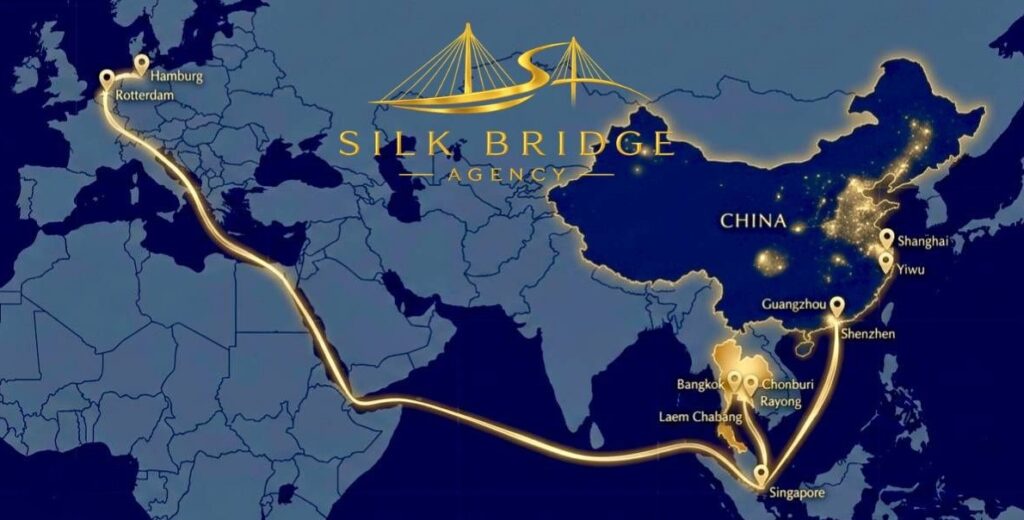

Helping businesses across Europe and the United States source products from China and Thailand with confidence.
Helping businesses across Europe and the United States source products from China and Thailand with confidence.
Contact:
We typically respond within 24 hours.
Where We Are